“This horse of yours hath too hard a trot”
The Decameron“This horse of yours hath too hard a trot” is Madam Oretta’s memorable metaphor for an intolerably badly told story. In the countryside, a gentleman offers to carry her along the road with one of the finest stories in the world; when his delivery makes the tale feel like a jolting ride, she asks him to set her down. The expression makes a tactful escape from tedious company sound like a playful adjustment to an uncomfortable journey.
The Story Behind the Metaphor
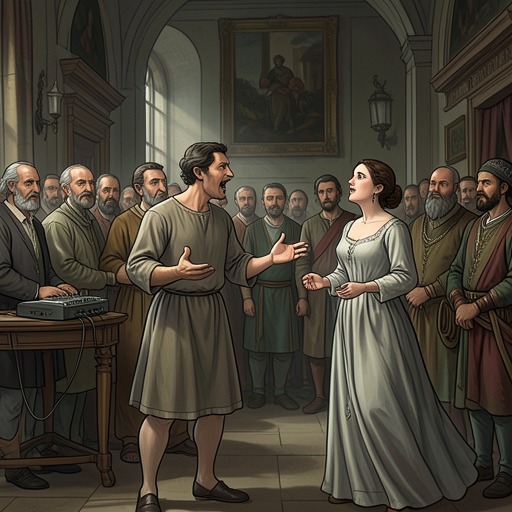
Madam Oretta, wife of Messer Geri Spina, is travelling on foot with a company of ladies and gentlemen after entertaining them to dinner at her house. One gentleman offers to make the long walk easier by telling her a story. She welcomes the offer, but his performance soon undermines his promise: he repeats words, turns back to correct himself, muddles names, and delivers the tale poorly.
The story itself is described as good, so the failure lies not in its subject but in its telling. The gentleman’s halting delivery repeatedly interrupts its progress. Listening becomes so uncomfortable for Madam Oretta that she feels faint and breaks into a sweat; at last, seeing him caught in a tangle from which he seems unlikely to escape, she intervenes.
A Courteous Rebuke
Rather than directly condemn the storyteller, Madam Oretta addresses the experience his performance has created. Her horse-and-ride conceit extends the gentleman’s own offer to carry her through the journey: if his story is the mount, its hard trot has become too much to endure. She asks, “Sir, this horse of yours hath too hard a trot; wherefore I pray you be pleased to set me down.” The request to be set down is both the punchline and a graceful instruction to stop.
The line’s wit depends on the contrast between the gentleman’s promise of a fine story and the discomfort of hearing it. The story he meant to use as a pleasant vehicle has become a bad ride. The metaphor lets Madam Oretta deliver an unmistakable rebuke while keeping it framed as a joke rather than an open quarrel.
The Exchange’s Resolution
The gentleman understands the hint better than he has managed the tale. He takes the jest in good part, laughs, turns to other subjects, and leaves the story unfinished. The expression therefore does more than mock poor storytelling: within the scene, it succeeds as a concise act of conversational redirection, ending an awkward performance without prolonged embarrassment.